


Traveling Through Frequencies
Find your path . . .

Open Source Science Initiative


Open Culture
To help build a culture of open science, NASA is championing a new initiative: the Open-Source Science Initiative (OSSI). OSSI is a comprehensive program of activities to enable and support moving science towards openness, including policy adjustments, supporting open-source software, and enabling cyberinfrastructure. OSSI aims to implement NASA’s Strategy for Data Management and Computing for Groundbreaking Science 2019-2024, which was developed through community input.
Immagine Credit:
Mergui Archipelago
NASA ID: GSFC_20171208_Archive_e001630
NASA image acquired December 14, 2004
https://images.nasa.gov/details/GSFC_20171208_Archive_e001630

Geography
Solar system, Planets and Moons
Credits :
The New Solar System
NASA ID: PIA02973
This solar system montage of the nine planets and four large moons of Jupiter in our solar system are set against a false-color view of the Rosette Nebula.
-
Date Created:2000-11-06
-
Center:JPL
-
Secondary Creator Credit: NASA/JPL/ASU

New Discovery
Battery Lab
NASA ID: GRC-2016-C-09929
NASA Glenn Researcher James Wu assembles a lithium-metal based battery lab cell incorporating a new solid polymer nanocomposite electrolyte developed at the center.
-
Date Created:2016-12-20
-
Center:GRC
-
Keywords: lithium , electrolyte , battery , polymer , research
Universe Exploration
Credit:
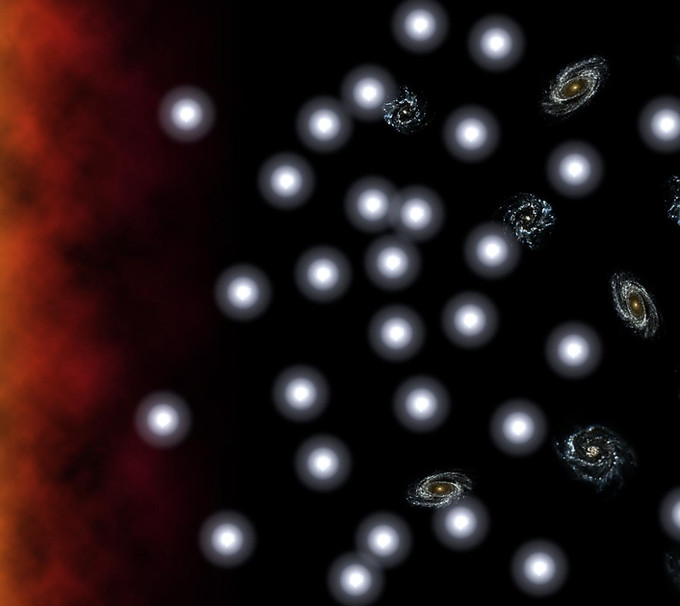
Baby Galaxies in the Adult Universe
NASA ID: PIA07142
This artist's conception illustrates the decline in our universe's "birth-rate" over time. When the universe was young, massive galaxies were forming regularly, like baby bees in a bustling hive. In time, the universe bore fewer and fewer "offspring," and newborn galaxies (white circles) matured into older ones more like our own Milky Way (spirals). Previously, astronomers thought that the universe had ceased to give rise to massive, young galaxies, but findings from NASA's Galaxy Evolution Explorer suggest that may not be the case. Surveying thousands of nearby galaxies with its highly sensitive ultraviolet eyes, the telescope spotted three dozen that greatly resemble youthful galaxies from billions of years ago. In this illustration, those galaxies are represented as white circles on the right, or "today" side of the timeline. The discovery not only suggests that our universe may ...more
-
Date Created:2004-12-21
-
Center:JPL
-
Keywords: Galaxy Evolution Explorer GALEX , artist concept
-
Secondary Creator Credit: NASA/JPL-Caltech

More Archives
Photo/Video Researcher Portrait
NASA ID: NHQ202001240001
“My journey to NASA was an interesting path for me because I never set out to work at NASA. I saw an ad online for a position at NASA Headquarters for a video librarian… and things just opened up for me here. “I have to admit that being a part of this agency really helped to not only support me in the times that I needed it the most, but it also offered me some really amazing and unique experiences. How many people get to see rocket launches? Or have ever seen a shuttle mission? Or had that direct experience of being a part of history, that transcends race, culture? To be a part of an agency that just does really amazing work that touches everybody’s lives — I’m just grateful.” NASA video librarian and researcher, Sheva Moore, Friday, Jan. 24, 2020 at NASA Headquarters in Washington. Photo Credit: (NASA/Aubrey Gemignani)
-
Date Created:2020-01-24
-
Center:HQ
-
Keywords: DC , Faces of NASA , NASA Headquarters , Portrait , Sheva Moore , Washington
-
Albums: We_Are_NASA_Portraits, Faces_Of_NASA_Portraits
-
Location:NASA Headquarters
-
Photographer:NASA/Aubrey Gemignani

Arts
ARC-1976-AC76-1267
NASA ID: ARC-1976-AC76-1267
NASA Art by Rick Guidice The Torus Wheel from 'Space Settlements; A Design Study' in colonization sponsored by NASA Ames, ASEE and Stanford University in the summer of 1975 to look at all aspects of sustained life in space. (ref: NASA SP-413, library of congress catalog card number 76-600068)
-
Date Created:1976-08-01
-
Center:ARC
Join the Community
stay update and share new experiences (registration not requited , but for adding contents you must for safety reason be registered )